
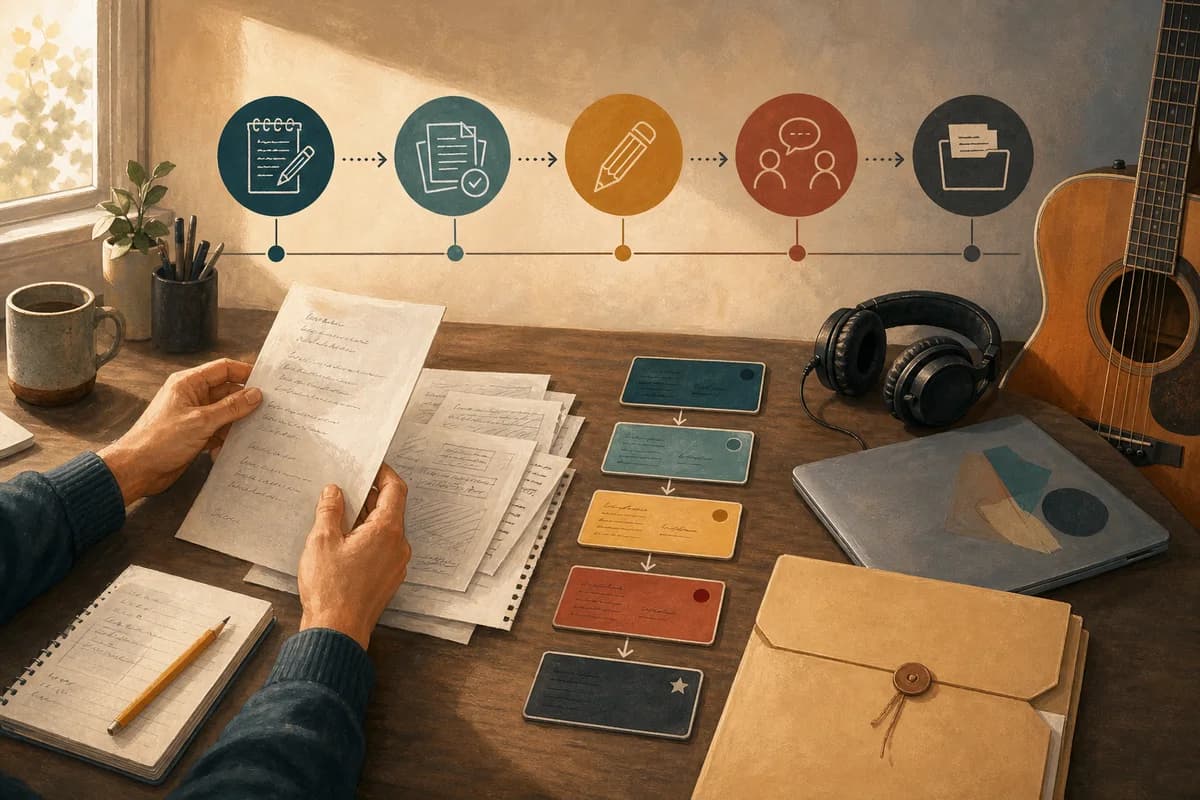
Finish more songs by making the next decision smaller. Instead of opening a new draft whenever a song becomes difficult, keep a short loop: capture the idea, choose a direction, revise one layer, review the result and hand off a version you can return to.
The aim is not to force every idea to become a release. It is to stop losing promising work simply because the next step is vague. A named version and one honest note are often enough to keep a song moving.
Why unfinished songs pile up
Most unfinished songs do not disappear because the writer has no ideas. They disappear because the project has too many possible next moves. The verse could change, the chorus could be bigger, the lyric could be clearer or the production could take a different path. When all of those decisions stay open, starting another song feels easier.
Starting again can feel like progress
A fresh page gives you the pleasure of possibility without the awkwardness of choosing. The cost is a growing folder of beginnings that never receive a deliberate review. Keep the new idea, but give the current song a small, time-boxed pass first.
Memory is a poor version-control system
If your only record is “I liked the earlier one”, it is hard to find that earlier one or explain why it worked. A simple name such as “v3 — quieter verse, clearer hook” turns a feeling into a useful reference.
Use a five-step writing loop
The loop is deliberately modest. You can run it in one sitting or spread it across a week. Each step should leave the project easier to understand than it was before.
1. Capture the useful idea
Write down the line, melody note, chord movement or production image that made you stop. Add one sentence about why it matters. “The chorus feels like relief after a held breath” is more useful than a blank file called “new song”.
2. Choose one direction
Decide what this version is trying to become. Choose the central point of view, a broad structure and one emotional movement. You are not closing every option; you are giving this pass a job.
3. Revise one layer
Pick one layer to change: lyric clarity, section order, vocal delivery, rhythmic feel or production direction. Keep the other layers stable enough to tell whether the change helped. If the chorus needs a lift, change the lift before rewriting the whole song.
4. Review with fresh ears
Step away, then listen or read once without editing. Write two notes: what became clearer and what still needs a decision. Avoid turning the review into an endless list of flaws. One useful question is enough for the next pass.
5. Hand off a clear version
Save the lyric, structure, production notes and review together. If the song is moving into an AI-assisted generation workflow, the handoff should make the intention legible to the next tool or collaborator. If it is staying human-authored, the same brief keeps the writing room coherent.
Capture enough to return
A returning-you note can be short. Record the working title, the best current line, the section that needs attention, the decision made in this version and the next question. Five lines are enough to make tomorrow’s session feel like a continuation rather than a restart.
For a wider view of the work before generation, the AI songwriting workflow guide shows how a brief, structure, lyrics, review and handoff fit together.
Choose a stopping rule
Finishing does not mean polishing every syllable forever. Decide what “ready for the next stage” means before you begin. For a lyric, it might mean every section has a purpose and the hook is readable aloud. For a production brief, it might mean the energy movement and vocal focus are clear.
Use questions you can answer
Ask: can I explain what this song is about in one sentence? Does the chorus change the feeling? Can another person understand what I want reviewed? If the answer is yes, move the song forward and record what you are leaving for later.
Keep versions reversible
A stopping rule is safer when the earlier version remains available. You can make a bold revision without worrying that a useful phrase will vanish. Reversibility makes experimentation less dramatic and more frequent.
Keep human writing and AI planning distinct
Kordra Studio and Kordra Music support different parts of the process. Kordra Studio is the separate native macOS writing workspace in development for a human-authored song process. It is not the same product or job as AI-assisted planning.
For projects that need structured planning around Suno or Udio, Kordra Music is the available web workspace for planning, writing, reviewing and exporting AI-assisted work. Keeping those roles clear helps you choose the right next step without blurring who is making the creative decision.
A simple weekly example
On Monday, capture the idea and choose the direction. On Wednesday, revise one layer and name the version. On Friday, review with fresh ears and either hand off the current package or write the one question for next week. The cadence is less important than leaving a trace of each decision.
If you have several songs in progress, give each one a different job. One can be in lyric revision, one in structural review and one in handoff. That keeps variety without asking every project to be solved at once. The older project organisation guide has more practical advice for keeping prompts, lyrics and versions together.
The practical takeaway
To finish more songs, make progress visible. Capture the reason an idea matters, choose one direction, revise one layer, review with a stopping rule and keep the version reversible. A small, named handoff beats another unnamed beginning.