
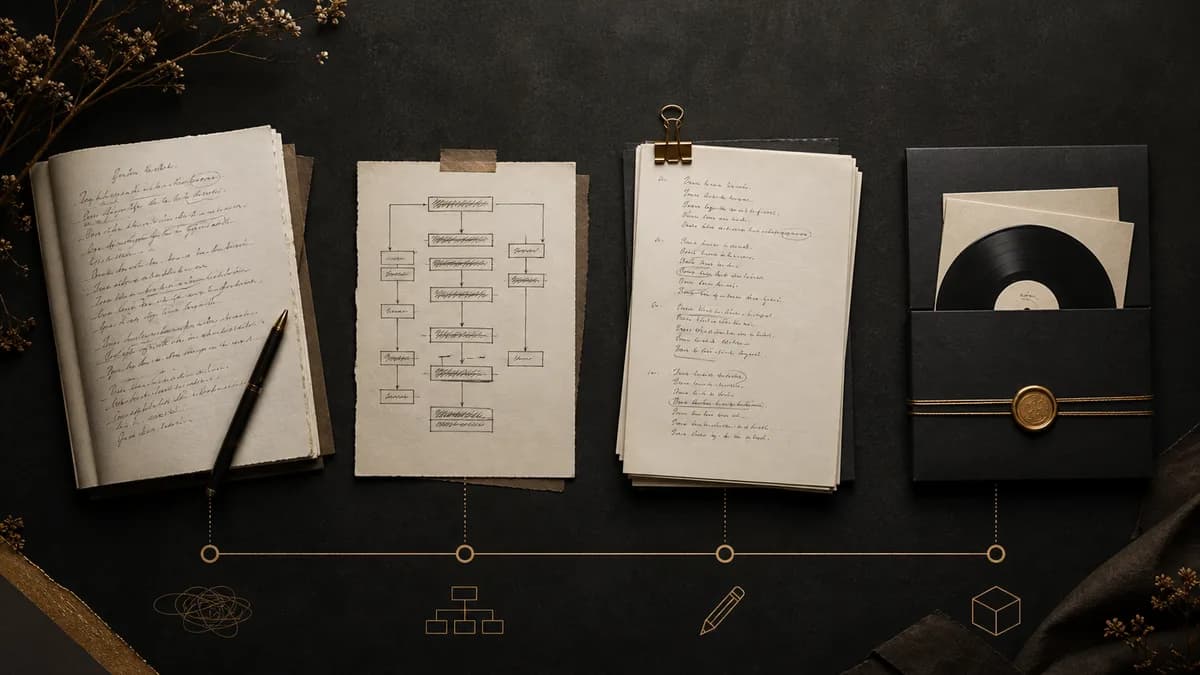
The most useful AI songwriting workflow starts before the model sees a prompt. It starts with a small human decision: what is this song trying to do?
That question is easy to skip when generation is fast. You can ask for a full song in seconds, but speed does not remove the work of choosing the idea, protecting the hook, shaping the structure, reviewing the weak spots and keeping the best version. It simply moves that work somewhere else.
A good AI songwriting workflow gives those decisions a clear place to live. It keeps the creative thread visible from the first brief to the final handoff, so the song does not become a pile of prompts, lyrics and audio links that are difficult to return to.
Start with the brief
Before writing a line, describe the song in ordinary language. What is the emotional centre? Who is speaking? What should change between the first verse and the final chorus? Which images, words or tensions need to stay?
This does not need to be a perfect prompt. It is a working brief: a few sentences that give the project a direction. The best briefs leave room for surprise while making the important choices visible. A genre label on its own is rarely enough. Add the mood, the point of view, the energy, the voice, the instruments and the kind of movement you want from the arrangement.
The public Kordra prompt guide is useful here because it treats a prompt as a production brief rather than a magic sentence. You can find it at https://kordra.io/knowledge/prompt-engineering.
Map the structure before you draft
A song can have strong individual lines and still feel as though it is standing still. Structure gives those lines somewhere to travel. Decide what each section is for before you ask a model to fill it.
A verse might introduce the world or narrow the point of view. A pre-chorus can create lift. The chorus should make the central idea easier to remember. A bridge can change the angle, remove an instrument or create a new kind of pressure before the last return.
This is not about forcing every song into the same template. It is about making contrast deliberate. Kordra Blueprints provide section maps that you can adapt, rather than treating a structure as a finished song. Browse them at https://kordra.io/knowledge/blueprints.
Write for meaning, not just completion
The first draft is allowed to be unfinished. It is often more useful to have a clear emotional direction and a weak line than a complete set of lyrics that says nothing specific.
Read the draft as a listener. Which line carries the song? Where does the language become general? Does the chorus answer the question raised by the verse? Are the performance cues helping, or are they adding decoration without changing the delivery?
A human review pass is where the project becomes yours. Keep the images that feel lived-in. Replace the phrases that could belong to anyone. Let the song have an uneven edge if that edge is part of its character. AI can help you explore options; it cannot decide which version means something to you.
Keep the decisions together
When the brief, lyrics, structure and review notes live in separate documents, each revision creates another chance to lose context. A useful songwriting workspace keeps the current decision beside the draft it belongs to.
That matters even more when you are comparing several versions. Give each version a simple name. Record what changed and why. Keep the rejected lines close enough to revisit without allowing them to blur the current direction. Version history is not administrative overhead. It is part of remembering how the song became itself.
Prepare a clean handoff
The final step in an AI songwriting workflow is not pressing Generate. It is preparing a package that another tool, collaborator or future version of you can understand.
A clean handoff usually contains:
- sectioned lyrics with performance cues that earn their place - a focused style and production direction - the song's tempo, energy and arrangement decisions - notes about what the next person should listen for - the version you actually mean to develop
Kordra Music is built around this planning and pre-production layer. It helps you shape the brief, write and review the song, then export a clearer package for Suno or Udio. The audio generation still happens in the generation platform; the value here is keeping the creative decisions connected before you spend a credit. Explore the workspace at https://kordra.io/products/music.
The workflow is the creative practice
It is tempting to think of planning as the part you do before the real work. For songwriting, the opposite is often true. The brief is where intention becomes visible. Structure is where emotion gets movement. Review is where taste enters the process. The handoff is where the song becomes usable beyond one moment of inspiration.
A better AI songwriting workflow does not ask you to surrender those decisions. It gives them a calmer place to live. Start with what the song is trying to say, keep the thread through each version, and let the model help with the parts that benefit from exploration. The finished result should still feel like a song someone chose to make.