
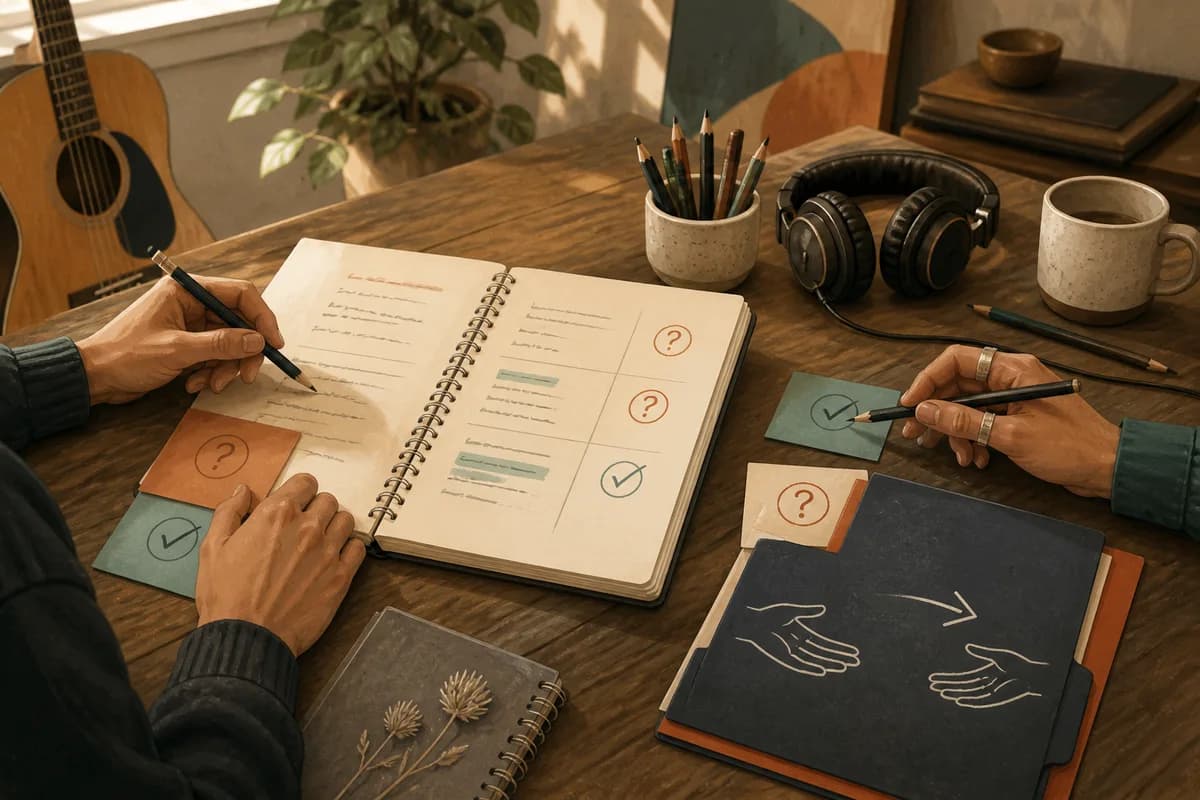
Co-writing an AI-assisted song becomes much easier when everyone can answer three questions: what are we making, what changed, and what needs a decision next? The most reliable song collaboration workflow is a small review loop: agree a brief, capture observations separately from decisions, send one focused pass, then hand over a named version with a short note. That keeps the creative conversation warm without turning a folder of generations into a maze.
Start with a shared song brief
Before anyone comments on a verse or a production direction, write down the job for this pass. A useful brief can fit on one screen: the working title, the emotional centre, the listener you have in mind, the part that is already working, and the one question you want your co-writer to answer. Add the target platform, such as Suno or Udio, only when it changes the way the material needs to be prepared.
Agree what this pass is for
A review that asks for everything at once rarely gives you a clear answer. Choose one priority. You might be checking whether the chorus earns its lift, whether the lyric is specific enough, or whether the production direction leaves room for a vocal. Say that priority at the top of the note. Your co-writer can still spot other issues, but they know where to spend their attention first.
Keep the working material together
Put the current lyric, prompt or production notes, and the latest export reference behind the same version name. A link in a message is useful, but it should point back to a stable place where the context is still visible. If a collaborator has to guess which of five near-identical files is current, the review has already lost energy.
Turn loose feedback into useful notes
Good collaboration notes are not a transcript of every reaction. They make the next decision easier. A simple split between observations, questions and decisions gives a co-writer somewhere to start.
Separate observations from decisions
An observation describes what you hear or read: “The second verse introduces a new image, but the point of view changes.” A question asks for a judgement: “Should the narrator stay in the room, or is that change deliberate?” A decision closes the loop: “Keep the new image and rewrite the final line to return to the room.” Keeping these categories distinct stops a passing thought from becoming an accidental instruction.
Ask for one change at a time
Specific requests are kinder than a large paragraph of mixed criticism. Try “Can you give the pre-chorus two shorter lines and keep the internal rhyme?” rather than “The build feels wrong.” The first request can be answered, accepted, adapted or declined. It also gives you a useful record of what was actually tested.
Build a review loop that respects attention
A collaboration rhythm should protect making time as well as review time. Agree when a pass is ready, how much feedback belongs in it, and what counts as a response. The aim is not to add process for its own sake; it is to stop every creative decision being reopened in every message.
Send a focused pass
Share one review package with a clear label, a short context note and three or fewer questions. If you are sending a lyric and an AI prompt together, explain which one is the source of truth for this pass. Give your co-writer permission to answer with “keep”, “change” or “park”. Those small choices are often more useful than a stream of unranked reactions.
Close the loop
When feedback arrives, reply with the outcome, not just “thanks”. Record what you accepted, what you changed, and what you are deliberately leaving alone. If an idea is good but not right for this song, park it with a note rather than letting it disappear into the chat history. A closed loop builds trust because both people can see that their time moved the song somewhere.
Make every handoff easy to pick up
A handoff is the moment another person takes responsibility for the next creative move. Make it feel like an invitation, not an archaeological dig.
Name the current version
Use a short, consistent name that tells you what changed: “Blue Room — v04 — chorus lift test” is more useful than “final-final-new”. Keep the version number moving forward even when the change is small. The name becomes a shared reference in notes, messages and exported files.
Write the two-minute handoff
A practical handoff note answers five things: where the song is now, what changed in this version, what still feels uncertain, what you would like the next person to try, and which earlier version is worth keeping nearby. End with a clear invitation, such as “Please choose between the two chorus endings and leave one line on the vocal space.”
Keep alternatives without creating chaos
Creative partners will not always agree, and that is healthy. The problem is not disagreement; it is losing the useful alternative or asking the same question forever.
Park good ideas safely
Keep a small “parked” section for lines, melodies, sounds and prompts that might return later. Give each item a reason: “strong image, but too intimate for this narrator” or “good texture, wrong energy for the bridge”. That preserves the work without making the current version carry every possibility.
Give each decision an owner
For a shared song, decide who has the final call on each layer. One person might own the lyric point of view while the other owns the production direction. Ownership does not remove discussion; it makes the moment of commitment visible. Once a decision is made, record it and let the song move.
A practical collaboration example
Imagine two co-writers working on a restrained electronic song about leaving a familiar place. Writer A sends version 04 with a brief: “Check whether the chorus feels earned without becoming triumphant.” Writer B replies with two observations, one question and a proposed four-line rewrite. Writer A accepts the image in line two, keeps the original final line, and marks the alternative as parked. The handoff for version 05 says exactly that, then asks Writer B to test a quieter final chorus and leave the vocal space open.
Nothing in that exchange is complicated. The clarity comes from naming the question, limiting the pass and recording the decision. The same pattern works when one person is writing and the other is shaping an AI prompt or reviewing an export: the creative ownership stays human, while the tools support a repeatable experiment.
Keep Kordra Music’s role honest
Kordra Music is the available web workspace for planning, writing, reviewing and exporting AI-assisted projects for Suno or Udio. You can use it as the structured source of truth for the brief, lyric decisions and handoff notes, then share the relevant version with your co-writer through the collaboration channel you already trust. Explore Kordra Music when you want the project context to stay together while you work.
For a longer view of the process, see the AI songwriting workflow from brief to clean export and the guide to organising Suno AI projects as a discography. They reinforce the same boundary: plan and review deliberately, keep versions understandable, and treat generation as one step inside a wider human-led workflow. The Kordra knowledge hub has further practical guidance as the project grows.
The practical takeaway
A good co-writer handoff is short enough to read and precise enough to act on. Start with one shared brief, label observations and decisions separately, ask for a focused review, name every meaningful version, and close the loop with a visible outcome. You do not need a perfect collaboration system. You need a reliable thread that lets both people return to the song, understand the latest choice and make the next one with confidence.