
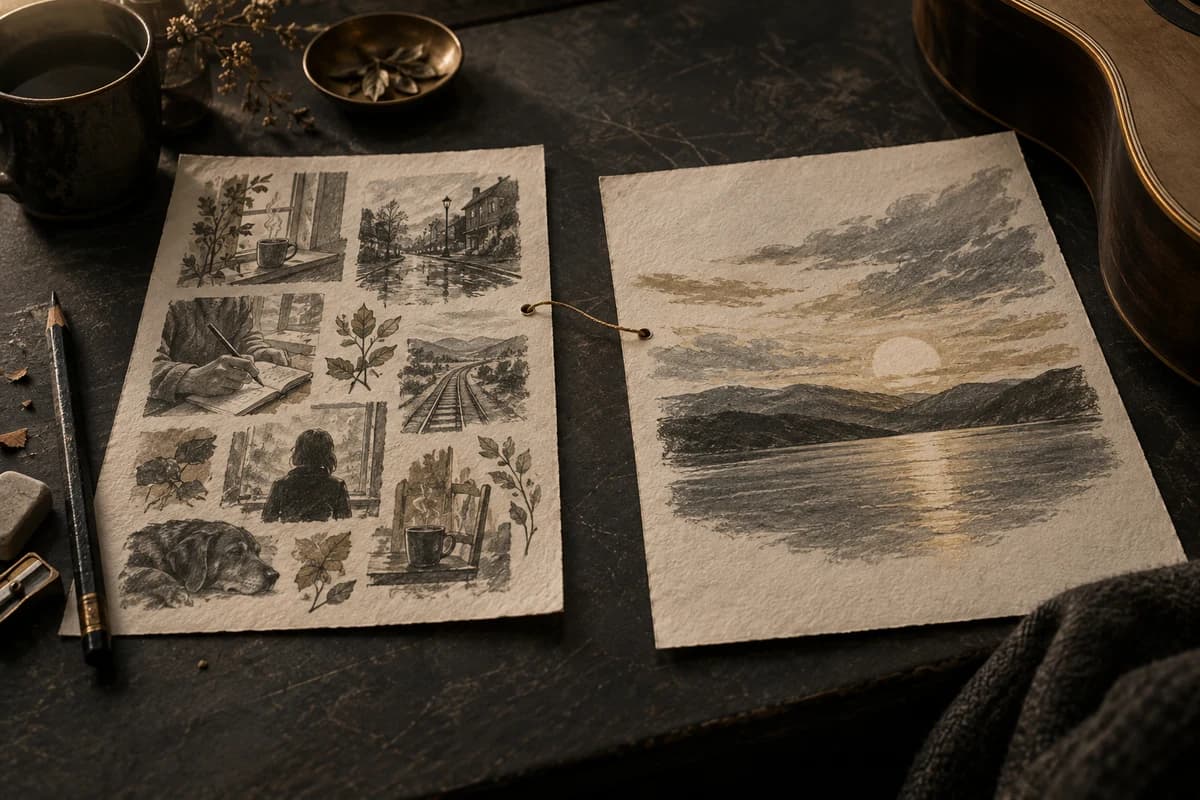
A verse and a chorus become easier to write when they are not asked to do the same work. Let the verse gather the details that make a situation feel real, then let the chorus widen those details into the line, promise or question you want a listener to remember. The contrast does not need to follow a fixed formula, but it gives every revision a useful test.
Start with the question each section answers
Before counting bars or choosing production language, write one sentence for each section. Ask what the listener should learn in the verse and what they should carry away from the chorus.
The verse gathers evidence
A verse can answer questions such as: where are we, what just happened, and which small detail proves that this feeling is more than a general mood? Specific objects, actions and changes of place give the listener something to follow. They also give you material to edit. If every line states the central emotion, the song has nowhere to move.
The chorus makes a claim
A chorus can turn those observations into a larger thought. It might make a promise, admit a contradiction, name a choice or ask the question the verse has been circling. Repetition is useful here because the section is carrying the song's centre, not because every chorus needs the same number of words or the same melody.
Try the difference with an original outline
The following is an illustrative example, written for this article rather than taken from a released song.
The brief is: someone leaves a late bus with an unfinished message on their phone and decides whether to walk home or turn back.
The verse gathers three pieces of evidence:
the last bus sighs at an empty stop;
a phone screen shows a message that was started and abandoned;
the walk home passes a lit kitchen where someone is still awake.
The chorus makes a wider claim: leaving the message unsent is also a choice, and the narrator can decide what to carry into the morning. A simple refrain such as “I can leave the light on” would be a placeholder for that claim, not a finished lyric. It gives the section a wider horizon without explaining every image from the verse again.
The point is not that a late bus belongs in a verse or that a light belongs in a chorus. Change the setting and the method still works. The verse supplies evidence; the chorus decides what the evidence means for this song.
Let the energy change with the job
Different lyrical jobs can support different kinds of movement. A detailed verse may benefit from a close, conversational delivery, a narrower melodic range or space around each image. A chorus that widens the thought might need a longer vowel, a clearer rhythmic pattern or a lift in register. Those are options to test, not rules that guarantee a better result.
Write the contrast into the brief before you ask an AI-assisted tool to help you explore production direction. For example:
Verse: close vocal, restrained pulse, room for three concrete images.
Chorus: wider vocal shape, steadier repetition, one sentence that can return.
Transition: remove one detail rather than adding a new explanation.
If a generated sketch or a new arrangement makes both sections feel equally busy, return to the job of each section before changing the words. Kordra Music can help you keep the concept, structured lyrics, revisions and production direction together while you prepare material for Suno or Udio. It plans the work around generation; the external platform generates the audio.
Use the bridge only when the song needs a new view
Once the verse and chorus have a clear relationship, check whether a bridge has a genuine job. It could change the narrator's knowledge, interrupt the established pattern or offer a final piece of evidence. If it only repeats the chorus in different words, remove it from the outline and see whether the song becomes clearer. A song can be complete without a bridge.
The same check applies to a pre-chorus. Keep it when it increases the pressure or changes the listener's expectation; shorten it when it delays a chorus that already has somewhere to go.
Apply the difference before generation
Make a compact planning note with five lines:
Verse job: what specific scene, action or image must become clear?
Chorus job: what claim, promise or question should remain?
Contrast: what changes in detail, melody, rhythm or space?
Review question: what will you listen for in the next version?
Keep or change: which decision is provisional and which one is now part of the brief?
This note is useful even if you never use an AI music tool. If you do use one, it gives each generation a creative reason. Instead of asking for “a bigger chorus”, you can ask for a chorus that turns three close observations into one open decision, then listen to whether the result actually does that.
Check the draft by listening, not only by reading
Read the verse and chorus on the page, then speak them aloud and sing a rough pass. Notice where your breath changes, where a repeated phrase becomes easier to remember and where the chorus still sounds like another verse. A comfortable syllable count is only one clue. The useful question is whether the performance makes the sections feel different while keeping them part of the same song.
Keep the review narrow. On the first pass, listen for the section's job. On the second, listen for energy. On the third, decide whether a line is doing useful work or merely explaining an image you have already shown.
For a broader structure check, see Song structure for AI music: verse, chorus, bridge and energy. It covers the larger map; this exercise focuses on the contrast between two central sections.
Keep the decision beside the project
When the outline is ready, explore Kordra Music and keep the concept, lyrics, review notes and production direction in one planning workspace. You remain responsible for the creative decision, and you can take the prepared material into Suno or Udio when you are ready to generate externally.
A practical takeaway
Write one honest sentence for the verse and one for the chorus. Add three specific details to the verse sentence, then reduce their meaning to one claim or question for the chorus. Try one rough performance or planned generation, listen for the contrast, and change only the section that is not doing its job.