
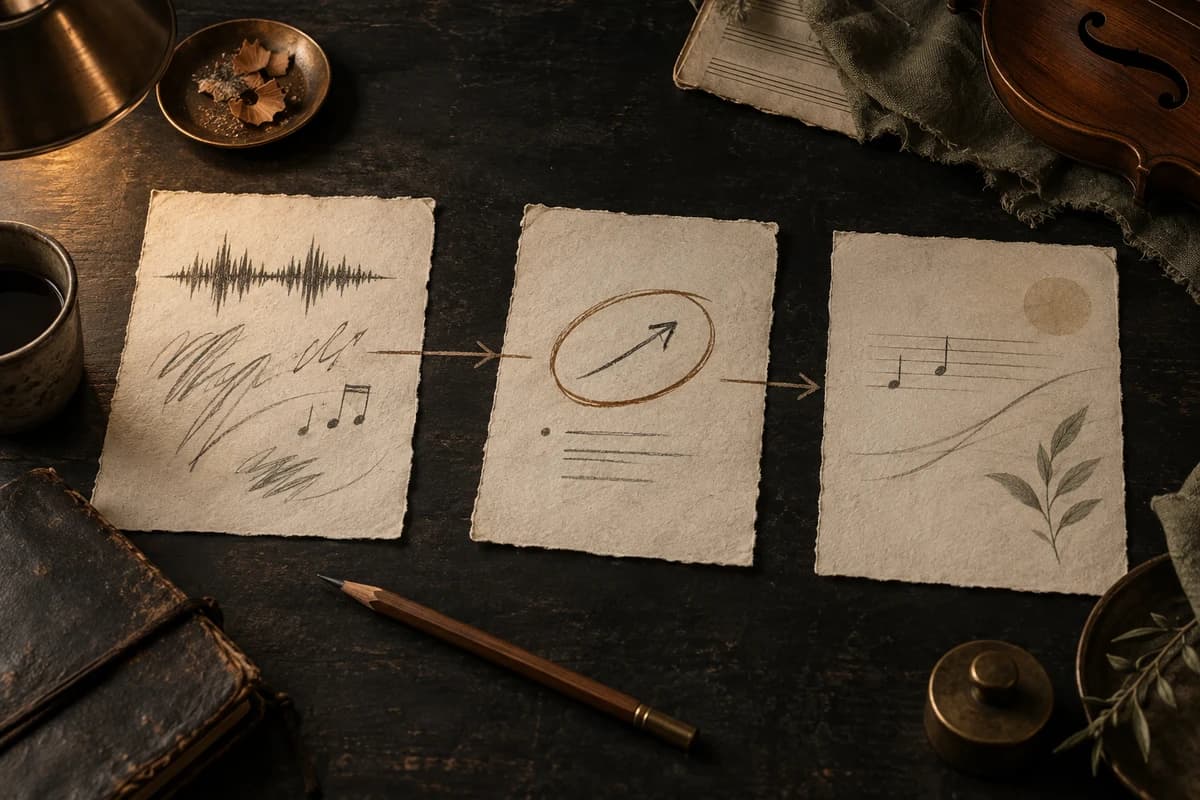
A useful review note does more than say that a draft feels wrong. It records what you noticed, names the effect you want instead and chooses one change to test next. That simple structure keeps a review close to the work: observation, intention, experiment.
Separate what you heard from what you want
Start with the evidence in front of you. “The second chorus loses the lyric” is an observation. “Make it more powerful” is a wish. Both may be honest, but they are not the same kind of note. Keeping them separate stops a vague reaction from turning into an unfocused rewrite.
Write one observable sentence
Describe a moment that another person could find in the draft. Mention the section, line, transition or energy change. You do not need technical language. “The verse image is clear, then the pre-chorus repeats the same thought” is specific enough to revisit.
Name the intended effect
Ask what the listener should notice after the change. You might want the chorus to feel more open, the verse to sound less explanatory or the handoff to make one decision easier to understand. An effect is a direction, not a promise that the next version will achieve it.
Use an original three-line example
The following example is illustrative and written for this article. It is not a customer result.
Imagine a draft about returning to a childhood street. The review note reads:
Observation: The first chorus contains three new images, so its repeated idea is difficult to remember.
Intended effect: Let the chorus carry one clear return-home feeling while the verse keeps the detail.
Next test: Move the street sign and garden image into verse two, then sing a shorter chorus without adding a new metaphor.
The note gives you a controlled experiment. You can compare the original and the revision without pretending that a shorter chorus is always better. If the result loses something important, record that as the next observation instead of defending the first plan.
Keep one change visible at a time
Review notes become difficult to use when they contain five unrelated fixes. Split them into separate passes:
Section job: is each part doing what the outline asks?
Lyric clarity: can you follow the image or thought on a first listen?
Delivery: does the phrasing leave enough space to sing the important words?
Production direction: does the brief support the intended change in energy or space?
You can notice several problems in one sitting, but choose one primary test. The other observations can wait in the history. A narrow pass makes it easier to say what changed.
Put the note beside the version it describes
Never leave a review comment floating away from the lyric or production brief that prompted it. Record the version, the section and the question you were answering. “V2, second chorus: does the repeated line land before the arrangement opens?” is more useful than “chorus needs work”.
Kordra Music’s current public workflow describes reviewing the draft, refining a weak spot, saving versions, notes and feedback beside the lyrics and production brief, then preparing the next attempt for external generation. Music helps organise the planning and review around generation; it does not generate the audio. Keep that boundary visible in the note so a changed brief is not mistaken for a changed recording.
Review with the next listener in mind
Write notes that would help a co-writer or producer understand the decision without making them guess what to do. That does not mean prescribing every performance detail. State the question, the evidence and the small test you want to hear.
For example, replace “make it less flat” with “the melody stays in the same narrow range through the pre-chorus; try one longer rising phrase before the chorus and keep the lyric unchanged”. The second note leaves room for interpretation while making the intended experiment clear.
Know when the note is complete
A review note is ready when someone can answer three questions:
What part of the draft are we discussing?
What did we notice there?
What will we try next?
If a note cannot answer the third question, it may still be a valuable observation. Mark it as an observation rather than disguising it as a solution. Some listening sessions are for learning what the song is asking for.
Use a small review loop before another generation
When you are preparing an AI-assisted project, make the review loop explicit:
Save the current lyric, concept and production direction as a version.
Listen to the draft or read the material aloud.
Write one observation, one intended effect and one change to test.
Make that change in the brief or lyric, not in an imagined result.
Prepare the next handoff for Suno or Udio only when you can name what the new attempt is testing.
The external platform will produce the audio, and its result may raise a new question. Bring that question back into the same loop instead of treating a generation as a verdict on the song.
Keep a practical next step
Try the three-line note on the next draft: observation, intended effect, next test. Explore Kordra Music if you want a web workspace for keeping concepts, lyrics, versions, review notes and production direction together before an external generation.
For a related handoff perspective, read AI music collaboration: notes, reviews and handoffs for co-writers. It looks at how a clear question helps another person pick up the work.
A practical takeaway
Write the note another listener would need: identify the moment, describe what you noticed, name the effect you want and choose one change to test. Save it beside the version, then listen again before adding another fix.