
To check whether a lyric is comfortable to sing, speak it naturally, try it against the intended rhythm and record a rough sung pass. Listen for where stress, breath or crowded words make the delivery work harder than you want.
Syllable count can reveal a difference between lines, but it cannot settle the musical decision. Two lines with similar counts may feel very different when the melody holds one word and moves quickly through another.
The test belongs in your voice and your song. An awkward phrase might need revision, a different melody or a deliberately unsettled delivery.
Start with what the sentence means
Read the line without the melody. Notice which words carry the thought and where you naturally pause. Then decide whether those are the words you want the listener to hear most strongly.
Consider this original illustrative line:
I never said that you should wait for me.
Emphasising “never”, “you” or “wait” can shift the listener's understanding. Before changing the number of syllables, decide what the line is trying to say. You may discover that the melody is drawing attention to a word that does not carry the intended meaning.
There is room to sing against natural speech. Use the difference deliberately and listen to whether it serves the song.
Try it at the song's pace
Speak or sing the line over a simple pulse or accompaniment. Notice where you accelerate to fit the words and where a held note asks a short word to carry more weight.
If a phrase feels crowded, try one small change. Remove an unnecessary qualifier, choose a more direct verb or move a detail to another line. Keep the image or meaning you care about in view.
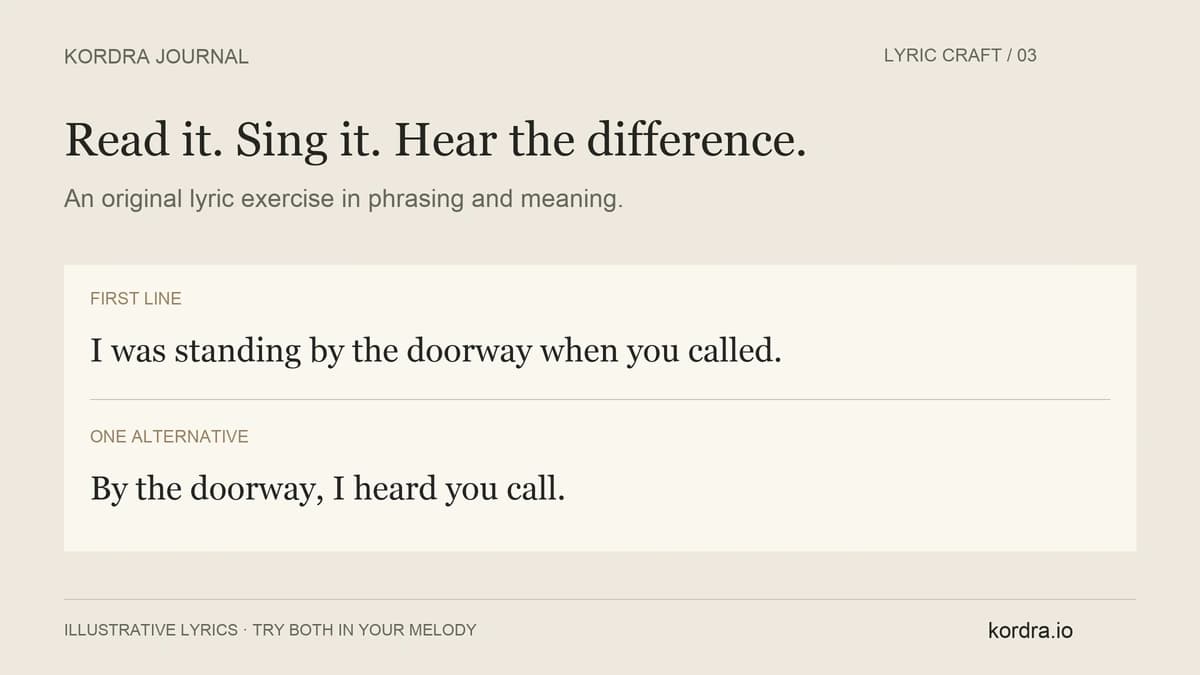
For another original example:
I was standing by the doorway when you called.
One alternative is:
By the doorway, I heard you call.
The revision changes both length and emphasis. The first places us in an unfolding scene; the second moves more directly to the call. Sing both before deciding. Shorter is not automatically more expressive.
Check the breath and the held word
Try the phrase in the register and tempo you expect to use. Where do you choose to breathe? Can you finish the thought with the delivery you want, or are you adjusting the meaning to reach the next breath?
Notice the word on any held note. Try it as written, then test an alternative or a different phrasing. Listen for intelligibility and expression rather than searching for a universal list of good and bad vowels.
An intentional broken phrase, quick rush or difficult articulation can be part of a performance. The question is whether you are choosing that effect and whether it communicates what you intend.
Record the experiment
Make a rough take of the original and another of the change. Keep enough surrounding material to hear the line in context. Comparing isolated words may hide how the phrase leads into the next section.
If you are using Kordra Studio, you can keep the lyric and related takes in the same local song workspace. Write the change, then record or import a new performance to hear it. Editing text does not alter the audio you already recorded.
When listening back, ask one question: is the meaning clearer, is the phrase easier to deliver in this melody, or does the line carry the feeling better? A smoother performance may be useful, but smoothness is not the only musical goal.
Keep the choice and its reason
Once you choose a version, leave a short note if it will help you return to the song. “Kept the longer line because the pause before ‘called’ matters” preserves a creative reason that a syllable total cannot.
You may also decide that the words are right and the melody needs room. That is a valid result of the test. The exercise helps you hear the relationship between language and music; it does not require the lyric to change every time.
For your next session, take one uncomfortable line through speech, pulse and a new sung take. Make one decision, then return to the song around it.
If you are considering a dedicated writing workspace, the Mac songwriting-app guide sets out useful criteria, and Kordra Studio shows the current product.