
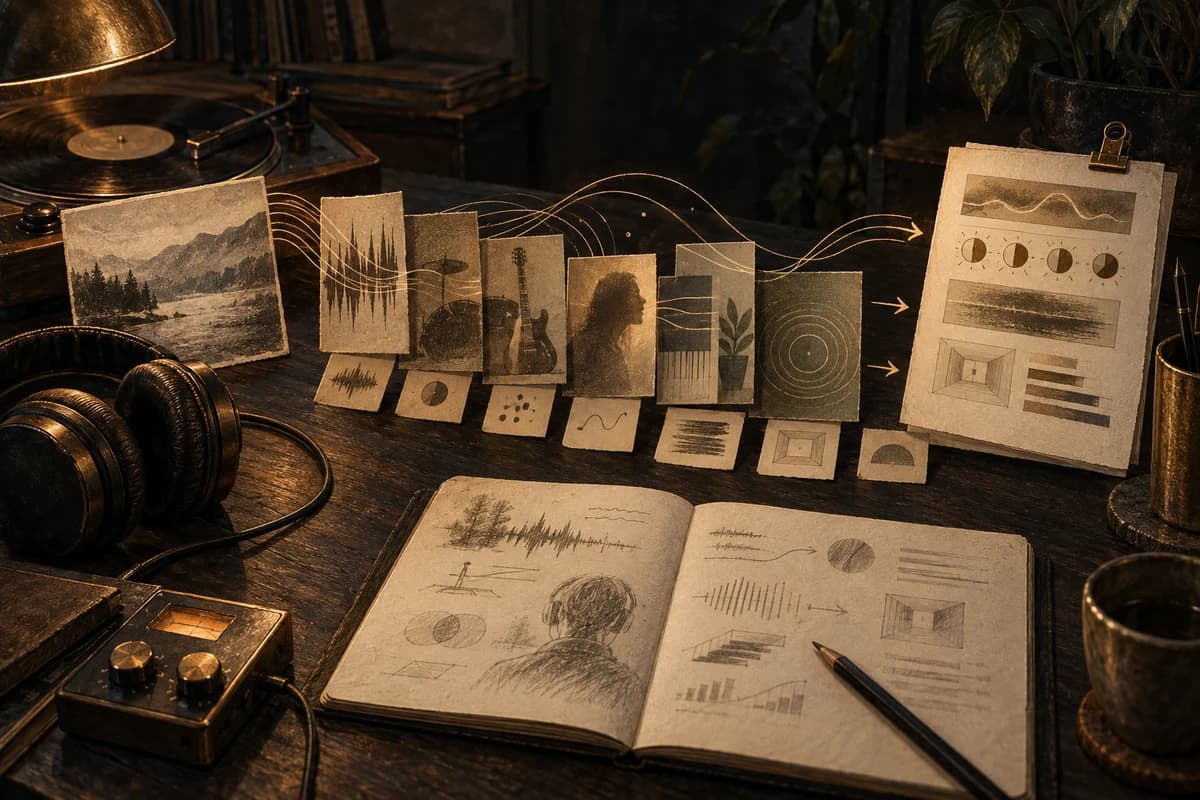
--> A musical reference becomes useful when you translate what you hear into decisions you can write down, review and test. Instead of naming an artist or asking for a copy of a track, describe the reference’s job: how close the vocal feels, where the energy opens, which instrument anchors the section and how much space surrounds it.
That small change turns a vague influence into a production brief. It gives the next Suno or Udio attempt something specific to explore, while keeping the song’s own lyrics, structure and identity under your control.
Start with what you actually notice
Play the reference once without trying to explain it. Notice the details that affect your listening: the distance of the vocal, the movement of the drums, the moment the arrangement gets wider, or the texture that makes the first section feel intimate.
Write observations before instructions. “The vocal sits close and almost conversational” is more useful than “make it sound like my favourite singer”. “The chorus opens with brighter guitars and a firmer kick” gives you choices you can hear and revise.
Keep the reference about qualities
Avoid copying lyrics, melodies or a recognisable performer. A reference can teach you about contrast, arrangement, delivery or atmosphere without becoming a request to imitate a particular artist. The aim is to understand what you are responding to, then make a fresh decision for your own song.
Turn observations into a short brief
Imagine an original song about leaving a familiar town. After listening to a reference, you might note:
a dry, close lead vocal in the verse;
muted electric guitar and a restrained drum pattern;
bass and wider backing vocals arriving in the chorus; and
a final section that feels open without becoming glossy.
The brief could become: “Intimate indie-pop with a close conversational lead. Keep the verse sparse with muted electric guitar and restrained drums. Let the chorus widen through bass, brighter guitars and a small backing-vocal lift. Keep the final section spacious and human rather than polished into a huge finish.”
This is not a magic prompt. It is a set of choices that another person—or your future self—can read, question and adjust.
Map the reference to the song’s movement
A reference is often most useful when you connect its qualities to sections. Ask where the song holds back, where it turns and what earns the final lift. You might write “verse stays close, pre-chorus adds breath and harmonic tension, chorus widens, bridge removes the drums before the last return”.
The map does not guarantee that a generation will follow it exactly. It gives you a listening plan. When you hear the result, you can ask whether the verse remained intimate, whether the chorus changed enough and whether the ending delivered the kind of release you intended.
Keep the lyric and voice decisions visible
Production direction cannot rescue a lyric whose point of view is still unclear. Note whether the words are finished, rough or only a section outline. Then describe the performance that helps those words land: restrained, breathy, direct, rough-edged or supported by a group response.
Keep those choices separate from a long list of genre labels. If the lyric needs to feel like a private admission, a close vocal may matter more than adding another instrument. If the chorus is a shared statement, a backing response may be the meaningful change.
Use the reference as a review checklist
Before generating, turn the brief into two or three questions. Did the chorus open without losing the song’s intimacy? Is the vocal close enough for the lyric to feel spoken? Does the final section add space rather than simply adding volume?
After the generation, listen for those questions rather than asking whether the track is generally good. Keep the parts that answer the brief, note the one decision that missed and change that decision in the next pass. A reference is most valuable when it helps you compare versions, not when it becomes another standard you can never reach.
Keep the brief beside the project
Kordra Music gives an AI-assisted song project a web workspace for the concept, lyrics, structure, production direction, review notes and versions. You can keep the reference observations beside the working brief, then prepare a focused handoff for Suno or Udio. The external platform generates the audio; Music keeps the decisions around that generation visible.
The prompt pre-flight checklist for Suno and Udio uses a similar separation between purpose, voice, structure, energy, production and lyric readiness. Use the parts that help you make the next decision, and leave any detail open until you have a reason to choose it.
Try one reference before your next generation
Write five observations about a reference without naming its artist. Turn them into three production choices, one section-and-energy map and two questions you can answer by listening. Save that brief, make one generation and revise only the choice that missed.
That process keeps the reference useful without letting it take over the song. You are not chasing a sound by description; you are making the next creative decision easier to hear. <!--