
Artificial intelligence has made music creation more accessible than ever. Platforms like Suno can transform a simple idea into a complete song in minutes, allowing anyone to experiment with genres, styles, lyrics, and production concepts.
Yet despite the incredible advances in AI music generation, many creators run into the same frustrating problem:
The songs sound generic.
The output may be technically impressive. The vocals might be clear, the instrumentation balanced, and the production polished. But something is missing. The song lacks identity, direction, and emotional impact.
If you’ve ever generated multiple Suno tracks that all seem to blend together, you’re not alone.
The good news is that the problem is rarely the AI itself.
The issue is usually the creative process behind the prompt.
Why AI Songs Often Sound Generic
Most creators approach AI music generation the same way they would approach a search engine.
They enter a simple prompt:
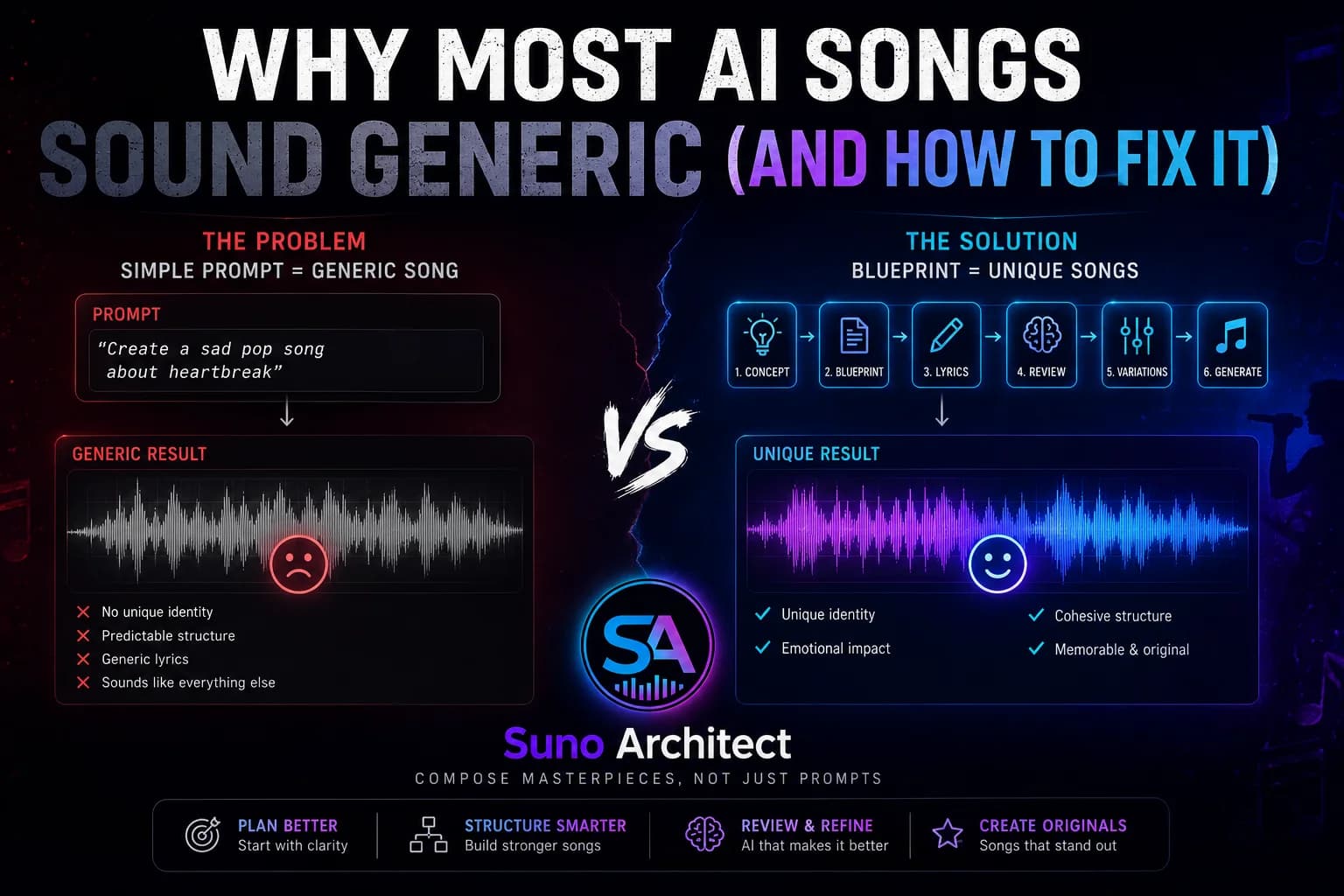
“Create a sad pop song about heartbreak.”
Or:
“Make an epic rock song with powerful vocals.”
While these prompts provide some direction, they leave huge creative gaps that the AI must fill on its own.
When the model receives limited information, it relies heavily on patterns learned from millions of songs and musical references. The result is often a safe, average interpretation of the request.
This isn’t a flaw in the technology.
It’s simply the AI making the most likely creative decision based on the information available.
The less creative direction you provide, the more generic the result becomes.
The Difference Between Prompting and Producing
Many creators think success with AI music is about finding the perfect prompt.
In reality, successful creators think more like producers.
A producer doesn’t walk into a studio and say:
“Make a hit song.”
They make dozens of creative decisions:
Genre
Mood
Tempo
Song structure
Vocal style
Instrumentation
Emotional arc
Lyrical themes
Audience
Production references
Every decision narrows the creative possibilities and shapes the final result.
The same principle applies to AI music generation.
The creators producing the most impressive Suno tracks aren’t necessarily writing better prompts.
They’re making better creative decisions before they generate.
The Hidden Problem: Lack of Structure
One of the biggest reasons AI songs feel generic is the absence of song planning.
Many creators jump directly into generation without considering:
What story is being told?
What emotional journey should the listener experience?
How should the song evolve from beginning to end?
What makes this song unique?
Without structure, the AI fills the gaps with familiar patterns.
The result often sounds competent but forgettable.
How Professional Songwriters Approach Songs
Professional songwriters rarely start with lyrics.
They start with a concept.
Before a single line is written, they often define:
Song Identity
What is the song actually about?
Not just the topic.
The deeper emotional message.
For example:
Topic:
Lost relationship
Concept:
Learning to move forward after losing someone who defined your identity
This creates much stronger creative direction.
Emotional Arc
How should the listener feel throughout the song?
A compelling song often changes emotionally.
Example:
Verse 1: Reflection
Verse 2: Regret
Chorus: Acceptance
Final Chorus: Empowerment
This progression creates momentum.
Structural Planning
Many generic AI songs suffer because every section feels similar.
Strong songs often use intentional contrast.
For example:
Verse = intimate
Pre-Chorus = tension
Chorus = release
Bridge = perspective shift
This gives the song movement and energy.
The Blueprint Method
One of the most effective ways to improve AI-generated music is to stop thinking in prompts and start thinking in blueprints.
A blueprint defines the creative foundation before generation begins.
A good song blueprint typically includes:
Genre
Instead of:
Pop
Try:
Modern synth-pop with cinematic undertones and atmospheric textures.
Mood
Instead of:
Sad
Try:
Nostalgic, reflective, bittersweet, gradually becoming hopeful.
Vocal Direction
Instead of:
Female vocals
Try:
Soft, emotional female vocal with subtle vulnerability and controlled power during the chorus.
Structure
Define the full structure:
Intro
Verse
Pre-Chorus
Chorus
Verse
Chorus
Bridge
Final Chorus
Outro
Lyrical Theme
Instead of:
Breakup
Try:
Rebuilding confidence after losing a long-term relationship that once defined your future.
Every additional detail gives the AI stronger creative boundaries.
Why Better Constraints Create Better Songs
Many people assume creativity comes from unlimited freedom.
In music, the opposite is often true.
Constraints create identity.
Consider these two prompts:
Generic
Create a pop song about love.
Structured
Create an emotional synth-pop song about reconnecting with your sense of self after a difficult breakup. Use nostalgic imagery, atmospheric production, intimate verses, and a powerful uplifting chorus. Female vocals with cinematic textures and a gradual emotional build.
The second prompt gives the AI far more direction.
The result is almost always more distinctive.
Iteration Is Where Great Songs Are Made
Another common mistake is treating the first generation as the final result.
Professional producers rarely accept the first version of anything.
They refine.
They edit.
They test alternatives.
They improve weak sections.
The same mindset applies to AI music.
Instead of generating once:
Generate multiple versions.
Compare structures.
Refine lyrics.
Improve emotional consistency.
Strengthen weak choruses.
Experiment with variations.
The creators producing standout AI music often spend more time refining than generating.
Using AI as a Creative Partner
The most successful AI musicians don’t treat AI as a replacement for creativity.
They use it as a creative partner.
AI excels at:
Generating ideas
Exploring possibilities
Creating variations
Testing concepts
Accelerating workflows
Human creators still provide:
Vision
Taste
Direction
Emotional understanding
Storytelling
The combination is where the best results emerge.
A Better Workflow for Suno Creators
Rather than:
Prompt → Generate → Hope
Consider:
Concept → Blueprint → Lyrics → Structure → Review → Variations → Generate
This workflow creates significantly more consistent results because every stage strengthens the creative foundation before generation begins.
Final Thoughts
The reason most AI songs sound generic isn’t because the technology is limited.
It’s because the creative process is often incomplete.
When creators move beyond simple prompting and begin thinking like producers, songwriters, and architects, the quality of AI-generated music improves dramatically.
The strongest AI songs are rarely created by chance.
They’re built through planning, structure, iteration, and creative direction.
The future of AI music creation isn’t about writing better prompts.
It’s about designing better songs before the AI ever starts generating.
Ready to Build Better AI Songs?
Suno Architect helps creators move beyond simple prompting by providing structured song blueprints, advanced lyric workflows, AI review tools, creative variations, and producer-focused planning systems designed specifically for Suno creators.
Because great songs don’t start with prompts.
They start with a blueprint. Sign up free today